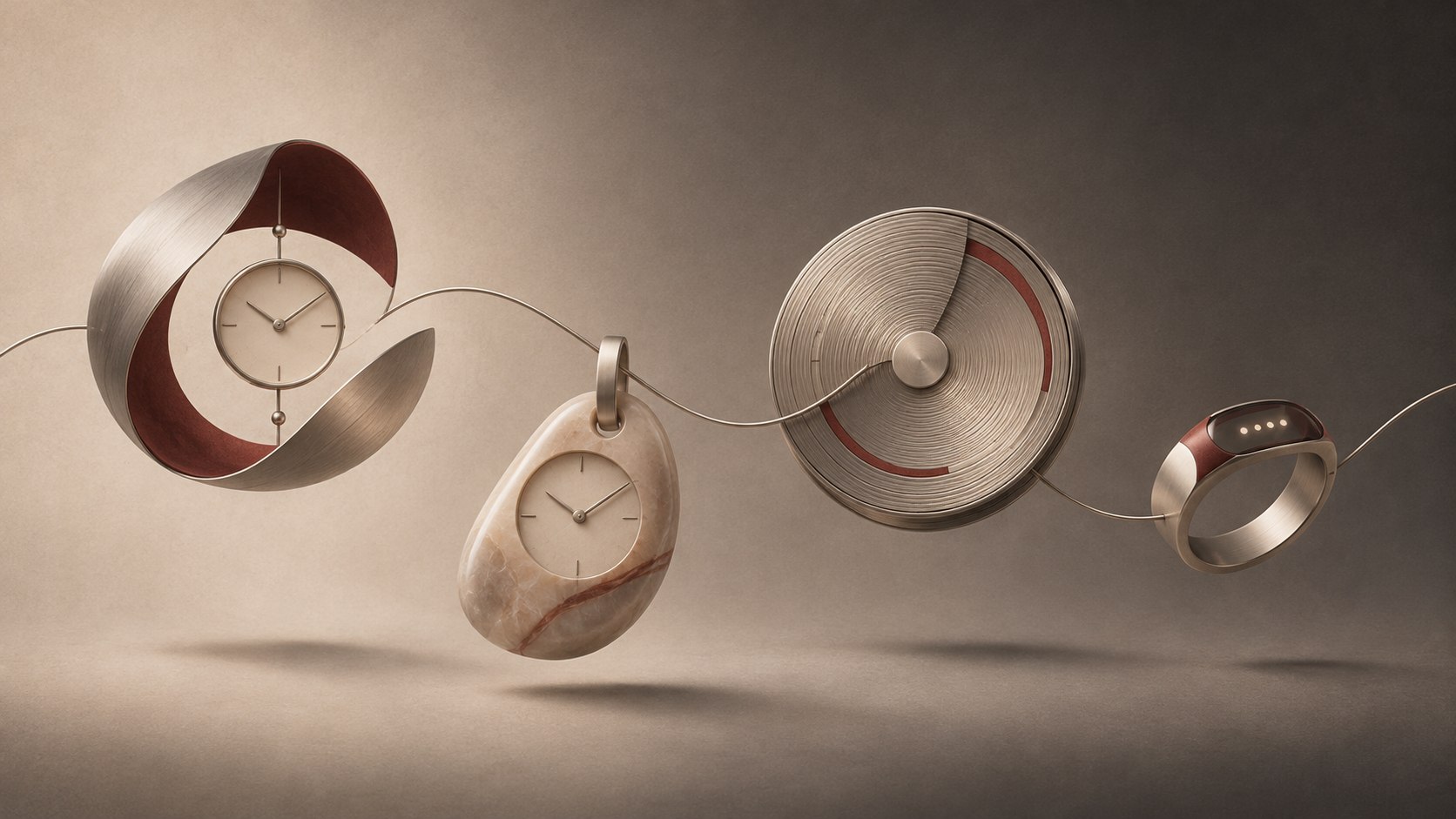
In November, the watch industry gathered in Geneva to celebrate its finest creations.
There were complicated chronographs, exceptional movements, extraordinary finishing and some of the most technically ambitious wristwatches produced this year.
But three of the winning timepieces shared a particularly unexpected quality.
None was designed to be worn on the wrist.
Chopard received the Jewellery Watch Prize for the Mystery Nut, a diamond-set walnut concealing a mechanical watch.
Piaget won the Gemset Watch Prize for the Swinging Pebble, a sculptural pendant suspended from a necklace.
And Audemars Piguet took the Calendar and Astronomy Watch Prize with the 150 Heritage, an extraordinarily complicated pocket watch.
These were not obscure prototypes sitting outside the competition.
They won established categories at the 2026 Grand Prix d'Horlogerie de Genève.
The evening's highest distinction, the Aiguille d'Or, went to Rexhep Rexhepi's Chronograph Flyback, a wristwatch. So I would not suggest that traditional wristwatches are suddenly losing their place.
But three awards for objects that do not belong on the wrist are difficult to ignore.
Especially when another manufacturer has been experimenting at the opposite end of the market.
Casio has developed a fully functioning G-SHOCK small enough to wear as a ring.
A luxury pocket watch containing 1,099 components and a miniature digital watch worn on a finger could hardly be more different.
Yet both challenge the same assumption.
Why does a watch have to sit on the wrist?
I find that question particularly interesting because, for most of watchmaking history, it didn't.
We Have Forgotten That Watches Once Lived Elsewhere
The wristwatch feels so natural today that it is easy to forget how recently it became the dominant format for personal timekeeping.
Before wristwatches became commonplace, portable timepieces existed in a remarkable variety of forms.
Some were suspended from clothing.
Others were worn around the neck.
Eventually, increasingly compact movements made watches practical to carry in pockets.
The Victoria and Albert Museum traces early portable clocks to the sixteenth century, when they could be worn around the neck or attached to clothing.
By the seventeenth century, miniaturization was making pocket watches increasingly practical.
And these early portable timepieces were not necessarily restrained instruments.
The Metropolitan Museum of Art's collections contain extraordinary examples with engraved gold cases, elaborate enamel work, gemstones and decorative forms that demonstrate just how closely watchmaking and jewellery were connected.
A portable watch could serve as a timekeeper.
But it could also be a demonstration of wealth, technical ingenuity or artistic skill.
Sometimes all three.
That historical context makes the modern fascination with pendant and pocket watches considerably more interesting.
We tend to describe them as unconventional because we have become accustomed to the wristwatch.
But the wristwatch itself was once only one possibility among several.
And perhaps the 2026 creations are not so much inventing a new category as rediscovering the freedom watchmakers had before the wrist became the obvious destination.
Chopard Put Time Inside a Walnut
Of the three unusual GPHG winners, Chopard's Mystery Nut is probably the most unexpected.
At first glance, it is not immediately identifiable as a watch.
It resembles an elaborate piece of high jewellery inspired by a walnut.
The shell is sculpted from 18-carat rose gold and set with diamonds, giving the object an extraordinarily detailed, organic appearance.
But the walnut opens.
Inside sits a mechanical watch with a moonphase display, powered by a self-winding movement.
The creation is worn as a pendant rather than attached to a wrist.
Chopard describes it as a one-of-a-kind secret watch, produced through the combined skills of its watchmakers and jewellery artisans.
And I think the word secret is particularly revealing.
In most contemporary watches, the time display is the central feature.
Everything else is arranged around it.
The dial occupies the front of the case. The hands are intended to be visible. Even highly complicated movements generally retain some recognizable relationship to the task of telling time.
The Mystery Nut reverses that hierarchy.
The object exists first as a sculptural piece of jewellery.
Only when it is opened does the watch reveal itself.
That changes the experience entirely.
You cannot simply glance at it to check the time.
You have to interact with the object.
There is an element of discovery involved in revealing the movement and dial.
And that makes the watch's mechanical function feel less like an everyday necessity and more like a private detail.
I find this a fascinating contrast with contemporary luxury watches whose value is often communicated through immediately recognizable designs.
The Mystery Nut does not need to announce that it is a watch.
In fact, much of its appeal comes from concealing that information.
Of course, this is an extraordinarily expensive and impractical way of telling the time.
But judging it exclusively by its practicality misses the point.
The watch is part of a larger artistic composition.
And in that context, hiding the time may be as important as displaying it.
Piaget Turned a Watch Into a Stone You Can Wear
Piaget's Swinging Pebble approaches the same idea through an entirely different design language.
Rather than concealing a watch inside an elaborate mechanical surprise, Piaget integrates a time display into the form of a polished ornamental stone.
The result is suspended from a long gold chain, creating a sautoir watch that belongs as much to jewellery design as to traditional watchmaking.
The 2026 collection draws on Piaget's history of experimenting with ornamental stones, unusual case shapes and jewellery watches.
The contemporary Swinging Pebble pieces use materials including tiger's eye, verdite and pietersite, emphasizing the natural colour and texture of the stone.
What I find particularly appealing is the decision not to make the object look conventionally mechanical.
The stone is allowed to remain the centre of the design.
The time display is incorporated into its surface rather than dominating it.
This is a very different philosophy from the familiar approach of taking a conventional watch case and decorating it with gemstones.
In that situation, the watch remains the primary object.
The jewellery is applied to it.
With the Swinging Pebble, the distinction is less obvious.
The form could almost exist independently of its timekeeping function.
Yet the dial adds another dimension to the object.
It becomes something that can be worn, appreciated visually and occasionally consulted for the time.
There is also something interesting about the way the pendant moves with the person wearing it.
A wristwatch is generally designed to remain relatively stable in its position on the wrist.
Its case and bracelet are engineered around that relationship.
A sautoir behaves differently.
It hangs.
It moves.
It becomes part of the wearer's clothing and the space around their body.
That creates possibilities for shape, materials and scale that do not necessarily make sense in a conventional wristwatch.
I don't think the Swinging Pebble represents a practical alternative to an everyday watch.
Nor does it need to.
It demonstrates that watchmaking can participate in jewellery design without being reduced to the technical component hidden inside the object.
And I would argue that this deserves to be taken seriously as watchmaking, rather than treated as a decorative side project.
Audemars Piguet Went in the Opposite Direction
If Chopard and Piaget are exploring watchmaking through jewellery and sculpture, Audemars Piguet's 150 Heritage is concerned with something very different.
Mechanical complexity.
Introduced in 2026 as part of the manufacture's anniversary celebrations, the 150 Heritage is an ultra-complicated pocket watch measuring 50mm in diameter.
Its manually wound Calibre 1150 contains 1,099 components.
Audemars Piguet identifies 40 functions, including 22 complications.
Among them are a minute repeater, a perpetual calendar, a split-seconds chronograph and a flying tourbillon.
The watch also incorporates a Universal Calendar mechanism housed within its caseback, bringing together astronomical and lunisolar information.
Those specifications are extraordinary.
But what interests me most is not simply the number of components.
It is the decision to create this watch in a format that most contemporary customers would never consider wearing.
For decades, the mechanical watch industry has invested enormous effort in miniaturization.
Manufacturers compete to make complicated movements thinner, more compact and suitable for increasingly refined wristwatch cases.
That is a remarkable technical discipline.
But the wrist also imposes limitations.
A watch must fit comfortably.
Its movement has to operate within a restricted space.
Pushers, correctors, crowns and displays need to be arranged around a case designed for the human body.
A pocket watch changes some of those requirements.
It does not eliminate engineering constraints.
A complicated pocket watch still demands extraordinary precision, thoughtful architecture and careful construction.
But it gives the watchmaker a different physical framework.
In the case of the 150 Heritage, that framework allows Audemars Piguet to combine a considerable range of complications within an object conceived as a demonstration of its technical expertise.
I also find the choice of format significant from a historical perspective.
Audemars Piguet built much of its early reputation on complicated pocket watches.
Returning to that form is therefore not simply an exercise in extravagance.
It connects the manufacture's contemporary capabilities with an important part of its own history.
Still, I think the watch raises a difficult question.
At what point does mechanical achievement become more about demonstrating what can be made than creating something intended for regular use?
I don't necessarily see that as a criticism.
A watchmaker should be allowed to explore technical possibilities without every creation needing to become a practical daily companion.
But it does change how we evaluate the result.
The 150 Heritage is not interesting because it offers a more convenient way of keeping time.
It is interesting because of the extraordinary expertise required to construct it.
In some respects, it belongs as much to the world of mechanical art as to conventional personal accessories.
And perhaps that is exactly where a watch of this kind should exist.
Then Casio Put a G-SHOCK on a Finger
At the other end of the industry, Casio has arrived at a similarly unconventional result through almost the opposite philosophy.
The G-SHOCK Nano DWN-5600, announced in October 2025, takes the unmistakable design of the familiar square G-SHOCK and reduces it to ring size.
This is not merely a decorative miniature.
According to Casio, the DWN-5600 has a functional digital display, calendar, dual-time and stopwatch capabilities.
It also retains a shock-resistant construction and water resistance rated to 20 bar.
Achieving those characteristics within something approximately one-tenth the size of a conventional G-SHOCK required considerable miniaturization.
But the result is also rather amusing.
A G-SHOCK is traditionally associated with durability, practicality and the idea that a watch should survive demanding conditions.
Reducing it to something worn on a finger changes that identity.
It becomes playful.
Almost absurdly small.
The kind of object that makes you look twice before deciding whether it is a watch, a ring or a particularly elaborate piece of miniature engineering.
And I think that is precisely why it works.
Casio has taken one of the most recognizable watch designs in the world and questioned something fundamental about its physical form.
The watch remains recognizable even when the proportions are transformed.
The digital display still tells the time.
The familiar design cues are still present.
But the experience of wearing it is entirely different.
There is an obvious practical argument against the idea.
A ring-sized watch is unlikely to be as convenient to read as a normal wristwatch.
And someone who simply wants to know the time probably has several easier options.
But convenience is not the only reason people enjoy watches.
The Nano is interesting because it turns miniaturization into an experience.
It invites the wearer to enjoy the object as an invention, rather than judging it exclusively by how efficiently it performs a familiar function.
What makes the comparison with Audemars Piguet especially interesting is that both are exercises in technical ambition.
One has created an extraordinarily complicated object too elaborate to fit the conventions of a normal wristwatch.
The other has made a familiar watch small enough to fit on a finger.
Different manufacturers.
Different customers.
Different prices.
But the same willingness to question the format.
And I think that is worth celebrating.
Are We Still Judging Watches by the Wrong Rules?
There is a recurring problem in how enthusiasts discuss unconventional watches.
We often evaluate them according to standards developed for conventional wristwatches.
Is it comfortable?
Is the dial legible?
Can it be worn every day?
Is the movement sufficiently accurate?
Those are perfectly reasonable considerations for many watches.
But they become less useful when the object was never intended to meet the same requirements.
A pendant watch should not necessarily be judged like a dive watch.
A pocket watch designed to demonstrate extraordinary mechanical complexity should not be assessed solely through its practicality.
And a ring-sized digital G-SHOCK probably does not need to outperform a conventional G-SHOCK in every aspect of daily use to justify its existence.
Different objects can pursue different ambitions.
The difficulty is deciding whether those ambitions are genuinely interesting.
Because not every unusual watch is automatically innovative.
Something can be strange without being thoughtful.
A surprising case shape might be a brilliant design decision.
Or it might simply be a way of attracting attention.
Similarly, an extraordinary number of complications does not automatically make a timepiece emotionally compelling.
Technical complexity can be admirable without necessarily producing an object someone wants to own.
I think the same critical standards should apply to unconventional watches as to ordinary ones.
What is the idea?
How successfully has it been executed?
Does the form serve that idea?
And does the result contribute something worth appreciating?
The answers may differ considerably between a diamond-set pendant and a miniature digital watch.
But that does not make the questions irrelevant.
In fact, asking them becomes more interesting when the familiar conventions disappear.
Watchmaking Doesn't Have to Be Practical to Matter
One of the arguments I find least convincing in modern watch collecting is that unusual mechanical creations are somehow pointless because we already have better ways to tell the time.
Of course we do.
A phone can display the time with extraordinary accuracy.
A basic quartz watch can perform the same task more conveniently than many elaborate mechanical creations.
And a smartwatch can provide functions that would be difficult, or entirely impossible, to reproduce through traditional watchmaking.
But the continued relevance of watches has not depended exclusively on practical superiority for a long time.
Mechanical watches can be appreciated for their engineering.
Jewellery watches can be appreciated for their artistic construction.
And experimental timepieces can be appreciated for the questions they ask about design.
That does not mean every invention deserves an enthusiastic response.
Nor does it mean practical watches have become uninteresting.
I still think there is something deeply satisfying about a well-proportioned everyday watch that performs its function without unnecessary complication.
But there should also be room for watchmakers who want to explore a different relationship between people, objects and time.
The wristwatch is one highly successful answer to the problem of portable timekeeping.
It is not the only one.
And the more watchmakers treat its familiar format as a possibility rather than an obligation, the more interesting the industry can become.
Is This Actually the Future of Watchmaking?
I would be cautious about calling these creations evidence of a new mainstream trend.
Three unusual winners at the GPHG do not mean the industry is abandoning wristwatches.
Nor does a ring-sized G-SHOCK indicate that millions of collectors are about to replace their everyday watches with miniature digital rings.
Most people who buy watches will probably continue to wear them on their wrists.
That remains an extraordinarily effective arrangement.
And there are good reasons it has endured.
But I don't think the significance of these creations depends on them becoming commercially dominant.
The most experimental objects in any design discipline rarely need to become everyday products in order to influence how people think.
Sometimes they reveal possibilities that established conventions have made difficult to imagine.
The Chopard Mystery Nut demonstrates how revealing time can become part of an artistic experience.
The Piaget Swinging Pebble explores what happens when jewellery determines the shape of a timepiece.
The Audemars Piguet 150 Heritage uses the pocket-watch format to pursue an exceptional level of mechanical complexity.
And the Casio G-SHOCK Nano turns a familiar tool-watch design into an exercise in miniature engineering.
None offers a single answer to the future of watchmaking.
That is what makes them interesting together.
They demonstrate that the industry does not have to move in one direction.
It can become more technically complicated.
More decorative.
More playful.
Smaller.
Larger.
Or simply less concerned with the conventions that have defined its most familiar products.
That variety is considerably more exciting than another collection of watches competing to look like the same successful luxury sports model.
Perhaps the Wrist Was Never the Point
I don't expect to replace my wristwatch with a gold walnut.
And I have difficulty imagining a complicated pocket watch becoming part of my ordinary daily routine.
Even the idea of checking the time on a ring would probably take some getting used to.
But I find all these objects compelling for reasons that have very little to do with convenience.
They demonstrate how watchmaking can continue to surprise us.
Not necessarily through increasingly complicated movements.
Not through higher prices.
And not through designs that become desirable simply because they resemble something already successful.
But by questioning the assumptions we have stopped noticing.
The wristwatch has become so dominant that we sometimes confuse its format with the entire discipline of watchmaking.
Yet the history of portable timekeepers tells a much broader story.
Watches have been worn as jewellery.
Carried in pockets.
Suspended from clothing.
And constructed as extraordinary objects of mechanical craftsmanship.
The wrist is only one chapter.
The 2026 GPHG winners and Casio's miniature G-SHOCK do not suggest that chapter is ending.
They remind us that others remain possible.
And perhaps that is the most interesting direction watchmaking can take.
Not trying to convince us that one more wristwatch is the ultimate expression of luxury.
But showing us something we had not thought to ask for.
A watch that becomes a sculpture.
A watch that hides inside a piece of jewellery.
A watch whose mechanical architecture seems almost impossibly ambitious.
Or a watch so small that it changes where we wear it.
Because the future of watchmaking may not be defined by a new movement, material or complication.
It may begin with a much simpler question.
Why does a watch have to look like a watch at all?
Sources and Fact-Checking References
- Grand Prix d'Horlogerie de Genève: Official 2026 Prize List — www2.gphg.org/en/news/prize-list-of-the-26th-grand-prix-dhorlogerie-de-geneve-gphg-rexhep-rexhepi-wins-the-2026-aiguille-dor
Confirms the November 7 awards and the winning Chopard, Piaget and Audemars Piguet timepieces. - Audemars Piguet: 150 Heritage Ultra-Complication Universal Calendar — www.audemarspiguet.com/us/en/watch-collection/150-heritage/75150PT.OO.01
Confirms Calibre 1150, 1,099 components, 40 functions and 22 complications. - Audemars Piguet: AP Talks, The 150 Heritage — www.audemarspiguet.com/us/en/news/savoir-faire/aptalks-the-150-heritage
Provides insight into the movement's development and construction. - Chopard: Mystery Nut Secret Watch — www.chopard.com/en-nz/gphg-mystery-nut.html
Confirms the one-of-a-kind walnut-inspired pendant, precious materials and concealed self-winding moonphase movement. - Piaget: Swinging Sautoirs and Cuff Watches — www.piaget.com/ch-en/high-jewelry/swinging-sautoirs-and-cuff-watches
Details the Swinging Pebble collection, ornamental stones and jewellery design. - Piaget: GPHG 2026 Award — www.piaget.com/ch-en/maison-piaget/news/gphg-awards-2026
Confirms the Gemset Watch Prize. - Casio: Official DWN-5600 Announcement, October 21, 2025 — www.casio.com/intl/news/2025/1021-dwn-5600/
Confirms the ring-sized G-SHOCK, shock resistance and 20-bar water-resistance rating. - Casio: G-SHOCK Nano DWN-5600 — gshock.casio.com/europe/products/g-shock-nano/dwn-5600/
Details timekeeping functions and miniature construction. - Victoria and Albert Museum: How Small Is Too Small? — www.vam.ac.uk/blog/international-initiatives/value-debates-how-small-is-too-small
Historical context on early portable watches and the development of pocket watches. - Metropolitan Museum of Art: Seventeenth-Century European Watches — www.metmuseum.org/essays/seventeenth-century-european-watches
Historical context on portable timekeepers, decorative cases and early watchmaking.