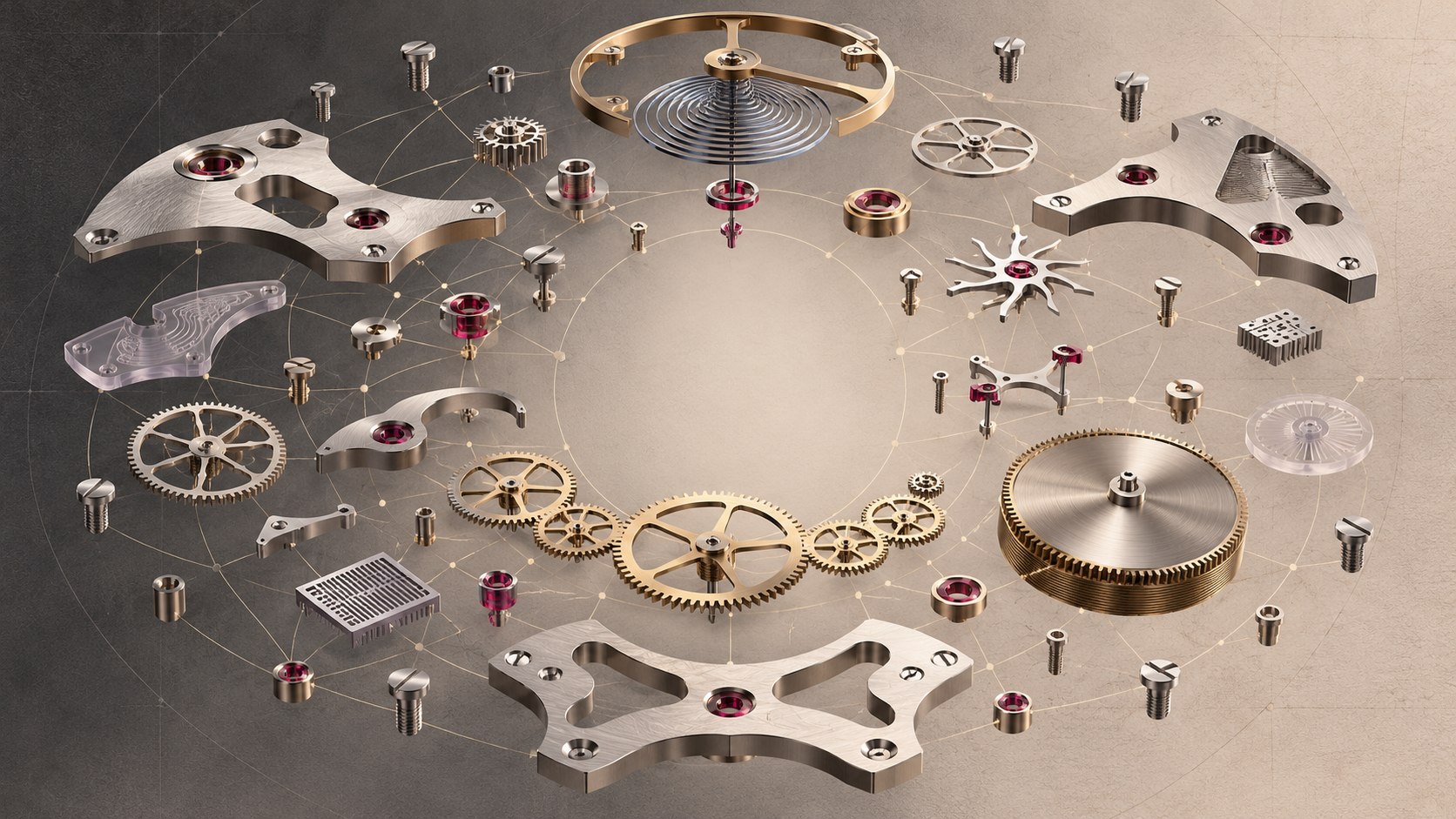
Imagine opening the caseback of a mechanical watch.
Beneath the rotor, bridges and carefully arranged wheels, you find a mechanism that appears to operate as one complete system.
Every component has a purpose.
The mainspring stores energy. The gear train transfers it. The escapement regulates its release, while the balance and hairspring provide the oscillations that allow the movement to measure time.
We tend to admire the finished result.
Perhaps we examine the finishing, recognize the movement architecture or appreciate the care involved in its construction.
But there is a question that rarely enters the conversation.
Who actually made all of it?
Not the name printed on the dial.
The people who manufactured the springs, cut the gears, developed the escapement, produced the microscopic screws and built the machines capable of manufacturing those components.
The answer is often considerably more complicated than the branding suggests.
Swiss watchmaking has never been defined exclusively by individual companies working in isolation. Its development has depended on an extraordinary network of specialized manufacturers, engineers and workshops.
Some produce complete movements.
Others manufacture individual components.
A few specialize in technical problems so demanding that even prestigious watchmakers rely on their expertise.
Many of these businesses are almost invisible to the people purchasing the finished watches.
And in 2026, that invisibility has become particularly interesting.
Because while certain luxury watchmakers continue to generate extraordinary value, the wider manufacturing network supporting the industry is confronting a different economic reality.
The question is no longer simply who makes your watch.
It is whether the industry can continue to depend on capabilities that may become increasingly difficult to sustain.
The Part of Your Watch You Never See
Consider the balance spring.
It is one of the smallest and most important components inside a traditional mechanical movement.
A thin spiral of carefully engineered material, it works with the balance wheel to regulate the watch's oscillations.
Its dimensions, material properties and manufacturing precision are critical to the movement's performance.
And producing it is not a simple matter of bending a piece of metal into the correct shape.
It requires expertise in metallurgy, precision manufacturing and the behaviour of materials under repeated mechanical stress.
The same principle applies throughout a movement.
A shock-protection system must respond to sudden impacts without compromising the regulating assembly.
A mainspring must store and release energy reliably over thousands of cycles.
An escapement must repeatedly transmit energy through extremely small interacting components.
Each presents its own manufacturing challenges.
And historically, many of those challenges have been addressed by companies whose names are largely unfamiliar outside the watch industry.
Nivarox-FAR is one example.
Part of the Swatch Group, the company specializes in essential components for mechanical movements, including regulating organs, escapements, balance springs and mainsprings.
Its operations span several production sites across the Swiss Jura Arc.
It is an industrial business built around precisely the kinds of components that allow a mechanical watch to function.
Yet most collectors would struggle to recognize its name as readily as they recognize the brands whose movements depend on such technology.
That imbalance says something interesting about how we understand watchmaking.
We celebrate the finished object.
But the industrial knowledge required to produce its smallest components can be just as remarkable as the movement itself.
And that knowledge does not necessarily belong to the company whose name appears on the dial.
The Names That Never Reach the Dial
Sellita is another important example.
Founded in La Chaux-de-Fonds in 1950, the company has developed into one of Switzerland's major independent mechanical movement manufacturers.
Its business extends beyond movement assembly.
Sellita controls essential stages of design and production, including movement blanks, regulating components, decoration and technical development.
It also manufactures movements that brands can use as a foundation for their own watches.
The significance of this is often misunderstood.
A movement supplied by a specialist manufacturer is sometimes treated as though it must be less interesting than one developed entirely within a watch brand.
But that assumption overlooks what a company such as Sellita actually represents.
Movement manufacturing is its specialty.
The company invests in the machinery, research, quality control and technical knowledge needed to produce movements at an industrial scale.
A watch brand purchasing one of those movements is not necessarily avoiding serious engineering.
It may be relying on a manufacturer whose entire business exists to perform that engineering well.
At a different level of the supply chain, Acrotec provides another revealing example.
The Swiss industrial group describes itself as the largest independent supplier of watch components to the country's premium mechanical watch market.
Its businesses specialize in everything from oscillating weights and spring barrels to shock absorbers, precision-machined components and silicon micromechanics.
Within the group, Générale Ressorts specializes in springs and energy modules.
KIF Parechoc is associated with shock-protection components.
Sigatec produces silicon micromechanical parts.
Other businesses provide precision turning, surface treatment, decoration and manufacturing equipment.
These are not merely interchangeable factories producing anonymous pieces of metal.
They represent highly specialized industrial capabilities.
And their existence allows watchmakers to draw on knowledge that would be extraordinarily costly to reproduce individually.
Perhaps an even more interesting example is Dubois Dépraz.
Based in the Vallée de Joux, the independent company has developed a reputation for chronograph mechanisms and mechanical complications.
Its history includes an important contribution to the development of the automatic modular chronograph introduced in 1969.
Today, it continues to develop complications, components and custom mechanisms for other watchmakers.
The relationship is significant.
A brand may be celebrated for a complicated watch whose technical development involved expertise beyond its own organization.
That does not automatically diminish the achievement.
It reveals that watchmaking innovation has often emerged through collaboration.
And sometimes the engineering partner deserves considerably more recognition than it receives.
Some of the Most Interesting Innovations Come From Outside the Brand
There is an even stronger argument against assuming that the name on the dial tells the complete technical story.
Consider Agenhor.
Founded in Geneva in 1996 by Jean-Marc Wiederrecht, the independent movement specialist develops mechanical complications for luxury watchmakers.
Its work has contributed to creations from houses including Hermès, Van Cleef & Arpels and Singer Reimagined.
One of its most significant developments is the AgenGraphe, an unconventional chronograph mechanism that required years of engineering.
Rather than simply refining an established chronograph architecture, Agenhor reconsidered elements of how the mechanism operates.
The project demonstrates a different kind of expertise from producing large quantities of standardized movements.
It involves identifying a technical problem, developing an original solution and translating that solution into a mechanism that can function reliably.
This is an important distinction.
The companies behind Swiss watchmaking do not all perform the same role.
Some excel at industrial precision and repeatability.
Others specialize in experimental mechanisms.
Some manufacture hundreds of thousands of components.
Others develop complicated movements in comparatively small quantities.
And certain companies combine several of those capabilities.
I find that variety considerably more interesting than the simple distinction between watches with in-house movements and watches without them.
Because innovation does not become less impressive when it originates outside the company selling the finished product.
In some cases, the specialist manufacturer may be precisely where the most original technical thinking occurs.
Swiss Made Doesn't Mean Made by One Company
There is another misunderstanding worth addressing.
The meaning of Swiss Made.
It is an important designation, protected through detailed legal requirements.
A qualifying Swiss watch must meet conditions involving technical development, the origin of its movement, assembly and final inspection in Switzerland, and the proportion of manufacturing costs generated in the country.
At least 60% of the manufacturing costs of the complete watch must be incurred in Switzerland.
Its movement must also satisfy separate Swiss-origin requirements.
But those rules do not require every component to be manufactured by one company.
Nor do they mean that every individual part must originate in Switzerland.
And they certainly do not establish that the name on the dial owns every factory involved in producing the watch.
That is not a criticism of the designation.
The Swiss Made framework has an important role in protecting manufacturing standards and the reputation of Swiss watchmaking.
But it should be understood for what it is.
A designation of origin governed by specific requirements.
Not a promise that one manufacturer has independently produced every component.
The distinction matters because the industry's commercial language can create a more romantic impression of manufacturing than the industrial reality.
We see photographs of watchmakers working at benches.
We hear about generations of craftsmanship.
We are introduced to the heritage of an individual manufacture.
All of those things can be genuine.
But behind them may exist a much wider network of companies contributing to the finished watch.
And perhaps we should become more comfortable recognizing that collaboration as part of Swiss watchmaking's strength.
Rather than treating it as something that needs to remain invisible.
More Money, Fewer Watches
The importance of this network becomes clearer when we examine the industry's recent economic performance.
Deloitte's 2026 report on Swiss watchmaking suppliers identifies a particularly striking development.
Between 2016 and 2025, Swiss watch export volumes declined by 43%.
Over the same period, export value increased by 34%.
Those figures describe an industry that has become substantially more valuable on a per-watch basis while producing considerably fewer watches overall.
There are several possible explanations for that shift.
Higher average prices.
Changes in product mix.
Stronger demand for prestigious references.
And the growing commercial importance of the industry's most expensive products.
For certain brands, this model can be highly attractive.
Selling fewer watches at substantially higher prices may support profitability, exclusivity and a carefully controlled commercial position.
But the economics can look different further down the supply chain.
A manufacturer producing specialized components must support machinery, employees, facilities, technical development and quality-control processes.
Many of those costs do not disappear simply because orders decline.
A factory designed to produce a substantial quantity of components cannot necessarily become more profitable by manufacturing half as many.
And a supplier may not possess the same pricing power as the luxury brand purchasing its products.
This is where the relationship between luxury value and industrial volume becomes important.
A watchmaker can potentially increase the value of its finished products through prestige, design, marketing and scarcity.
But the supplier manufacturing a spring, wheel or component may remain heavily dependent on production volumes and manufacturing efficiency.
Those are very different economic models.
Deloitte's findings demonstrate how seriously suppliers view this issue.
In its 2026 survey of 42 supplier and component-manufacturing executives, 79% regarded declining watch volumes as either a major structural risk or pressure to develop higher-value offerings and innovate.
That is not proof that the entire supplier network is approaching collapse.
But it is strong evidence that the industry is experiencing a structural problem.
And one that may not be visible when we look only at the financial performance of the most successful luxury brands.
The Recovery Doesn't Tell the Whole Story
There is an important complication to this argument.
Swiss watch exports have recently improved.
According to the Federation of the Swiss Watch Industry, exports grew by 9.1% in October 2026 compared with the same month in 2025.
The number of wristwatches exported increased by 12.9%.
All export-price segments recorded growth during the month.
Those are encouraging figures.
And they matter because it would be misleading to suggest that the industry's volume decline is continuing uninterrupted.
There are signs of recovery.
But one strong month does not erase the longer-term reduction in production volumes.
Nor does it tell us whether every supplier is benefiting equally.
The Federation itself cautions that export growth does not provide a complete picture of economic performance, particularly when companies are dealing with currency pressures, material costs and changing trade conditions.
Export figures also measure shipments abroad, not purchases by final customers.
I think that qualification is essential.
A recovery in the total value of exports can coexist with pressure on individual manufacturers.
Some suppliers may receive more orders.
Others may still be operating below their historical capacity.
Some may benefit from demand for more complicated, higher-value components.
Others may depend on the production of relatively ordinary movements used in larger quantities.
The industry is not one uniform business.
Its companies occupy different parts of the market, with different cost structures and customers.
And a headline celebrating stronger exports tells us relatively little about those differences.
This is why the future of Swiss watchmaking cannot be understood solely through the value of the watches it sells.
We also need to understand what is happening to the businesses that manufacture them.
When a Supplier Becomes Strategically Important
A development in November 2025 illustrates just how valuable specialist manufacturing capabilities have become.
Citizen announced that LVMH had invested in Manufacture La Joux-Perret, the Swiss movement manufacturer based in La Chaux-de-Fonds.
La Joux-Perret has belonged to Citizen Group since 2012.
Its expertise spans mechanical movements, complications and high-precision solar quartz technology.
The relationship with LVMH was not entirely new.
La Joux-Perret had already been supplying high-precision solar quartz movements to TAG Heuer and Tiffany & Co. since 2022.
But the investment formalized a deeper strategic relationship.
According to Citizen's announcement, the agreement was intended to strengthen movement supply and support future technical development.
That is significant.
Because it reveals something about the importance of the manufacturing businesses operating behind famous watch brands.
A specialist movement manufacturer is not simply a convenient supplier.
Its technical capabilities, production capacity and accumulated knowledge can become strategically important to an entire luxury group.
And the relationship can extend across national and corporate boundaries.
La Joux-Perret is a Swiss manufacture owned by a Japanese watchmaking group, with investment from one of France's largest luxury conglomerates.
That is a rather different picture from the romantic idea of an individual Swiss watchmaker manufacturing everything within a single historic building.
Yet it is also a genuine example of modern Swiss watchmaking.
The technical development takes place in Switzerland.
The company maintains its own manufacturing capabilities.
Its ownership and commercial partnerships reflect an increasingly international industry.
And its expertise is valuable enough to attract long-term investment from major watch businesses.
I find this considerably more interesting than another debate about whether a movement should be described as in-house.
The important question is who controls the expertise.
Who can develop it.
And who can access it in the future.
The Problem With Making Everything In-House
The term in-house movement carries enormous prestige in modern watch collecting.
It suggests technical independence.
Greater manufacturing control.
And a closer relationship between the watch's design and the movement inside it.
Sometimes those qualities are genuinely present.
Manufacturers that develop and produce their own movements can achieve extraordinary levels of integration between engineering and design.
They can also maintain direct control over technical decisions, production standards and future movement development.
Those are meaningful advantages.
But I do not think in-house manufacturing should automatically be treated as the highest possible expression of quality.
A movement produced by a respected specialist can be exceptionally reliable, well engineered and appropriate for its intended purpose.
A movement developed internally can be technically ambitious but expensive to maintain.
And a watchmaker may manufacture certain movement components itself while relying on external specialists for others.
The reality is rarely captured by a simple label.
There is also an industrial consideration.
When large manufacturers bring more production inside their own organizations, they may improve supply security and protect proprietary knowledge.
But if more of the industry's manufacturing capacity becomes concentrated within vertically integrated groups, smaller independent brands could face a different problem.
Access.
An independent watchmaker may not have the resources to produce every component.
Developing a movement from scratch requires investment, equipment, engineering expertise and time.
Reliable external suppliers allow smaller manufacturers to create watches without having to reproduce an entire industrial system.
That can encourage competition.
It can also enable originality.
A watchmaker may choose to invest its limited resources in an unusual design, original display or specialized complication while relying on an established supplier for other parts.
Without that option, the barrier to entering serious watchmaking becomes considerably higher.
So the relationship is more complicated than in-house manufacturing being good and outsourcing being bad.
The strongest industry may be one that supports both.
Manufacturers capable of developing extraordinary technology internally.
And a healthy independent supplier network available to brands that need specialist expertise.
What Happens When a Supplier Disappears?
There is another reason the current pressure on suppliers deserves attention.
Manufacturing knowledge is not always easy to replace.
A company might specialize in a particular component for decades.
Its employees may understand the behaviour of specific materials, the limitations of particular machines or the manufacturing methods needed to achieve extremely small tolerances.
Some of that knowledge can be documented.
Some can be transferred through training.
But much of it also exists through experience.
The adjustments made by a skilled technician.
The judgment developed through repeated production.
The ability to identify a problem before it becomes visible in the finished component.
These capabilities take time to develop.
And if a company closes, they do not necessarily transfer neatly to another manufacturer.
Machines can be sold.
Buildings can be repurposed.
But a highly specialized team may be much harder to reconstruct.
There are consequences beyond the immediate loss of jobs.
A smaller supplier network could reduce the choices available to watchmakers.
It could increase dependence on a limited number of manufacturers.
And it could make certain kinds of development more difficult or expensive.
This is not inevitable.
Consolidation can also provide stability.
A larger industrial group may be better positioned to invest in new equipment, develop technology and protect specialized skills.
Acrotec itself demonstrates how complementary manufacturing businesses can operate within a wider industrial organization.
Diversification offers another possibility.
Companies with expertise in precision manufacturing may find opportunities in medical technology, aerospace or other industries requiring similarly demanding production standards.
Deloitte identifies diversification, consolidation and technological investment as important ways suppliers are responding to current pressures.
So I would avoid presenting the future as a simple choice between independent workshops and industrial collapse.
The real question is whether the manufacturing knowledge remains available to watchmaking.
And whether enough companies can continue investing in it.
Collectors Should Be Asking Different Questions
Perhaps this entire discussion should change how we evaluate a watch.
Not by making every collector investigate the ownership structure of every component manufacturer.
That would be unreasonable.
Nor by demanding that every brand publish the identities of all its suppliers.
Commercial confidentiality, proprietary technology and competitive relationships are legitimate considerations.
But I think there is room for more curiosity.
When a manufacturer emphasizes its movement, we should be interested in what makes that movement technically distinctive.
When it uses the term in-house, we should understand what the company actually develops and produces.
And when a brand relies on an established specialist movement, we should be willing to appreciate the expertise behind that decision.
The same curiosity should extend to servicing.
A mechanical watch is often presented as an object capable of lasting generations.
That promise depends not only on the durability of the finished movement but also on the continued availability of components, technical documentation and qualified watchmakers.
A sophisticated movement is considerably less reassuring if maintaining it becomes difficult twenty years after purchase.
And perhaps long-term support deserves as much attention as the originality of the calibre itself.
There is another benefit to understanding suppliers.
It gives us a more complete appreciation of watchmaking.
A finished watch becomes more interesting when we recognize how many different disciplines contributed to its construction.
Metallurgy.
Micro-engineering.
Precision machining.
Movement architecture.
Decoration.
Assembly.
Testing.
And countless decisions that will never be visible to the person wearing the watch.
The finished object may carry one brand's identity.
But the knowledge behind it can be far more widely distributed.
That does not make the watch less special.
To me, it makes the achievement more remarkable.
Who Really Makes a Swiss Watch?
So who actually makes your Swiss watch?
The answer depends on the watch.
Some manufacturers control an extraordinary proportion of their production.
Others rely on established movement specialists or component suppliers.
Many operate somewhere between those two approaches.
And the exact relationships are not always publicly disclosed.
But I think the more important answer is that Swiss watchmaking is an industrial ecosystem, not merely a collection of luxury brands.
Its reputation has been built through the accumulated expertise of companies whose names are rarely celebrated outside the industry.
The people who develop regulating systems.
The businesses that manufacture precision components.
The engineers who create complications for other watchmakers.
And the specialist workshops that make ambitious designs possible.
For decades, this network has allowed Switzerland to sustain a remarkable concentration of watchmaking knowledge.
In 2026, the industry faces a difficult question about what happens when commercial value and manufacturing volume move in different directions.
Higher prices can support extraordinary craftsmanship.
But higher prices alone do not guarantee a healthy supplier network.
Prestigious brands can succeed while parts of the manufacturing ecosystem remain under pressure.
And a recovery in exports does not necessarily mean every workshop is recovering with it.
I don't think this means the Swiss watch industry is approaching some inevitable industrial collapse.
The sector has adapted to extraordinary changes before.
It has survived technological disruption, shifting consumer preferences and repeated economic challenges.
Its manufacturing companies are also responding through investment, diversification and new forms of cooperation.
There are reasons for optimism.
But the industry's future should not be judged exclusively by its most celebrated products.
Because the next great watchmaking innovation may not emerge from the company whose name eventually appears on the dial.
It may come from a specialist manufacturer developing a new material.
An engineer reconsidering an established complication.
Or a relatively unknown workshop solving a problem that the industry has struggled with for years.
Those companies deserve attention before their expertise becomes difficult to replace.
Perhaps the most remarkable thing about a Swiss mechanical watch is not that one manufacturer can produce such a complicated object.
It is that an entire network of specialized businesses has developed the knowledge to make it possible.
And if we truly care about the future of watchmaking, we should care about the future of that network too.
Because the most important name behind your watch might be one you've never heard of.
Sources and Fact-Checking References
- Deloitte, Swiss Watch Industry Insights 2026: Spotlight on the Supplier Universe — www.deloitte.com/ch/en/Industries/consumer/perspectives/swiss-watch-industry-spotlight-supplier-universe.html
- Federation of the Swiss Watch Industry, October 2026 Statistics — extranet.fhs.swiss/eng/statistics/pdf/comm_261010_a.pdf
- Swiss Federal Institute of Intellectual Property, Swiss Made Ordinance — www.ige.ch/en/law-and-policy/national-ip-law/indications-of-source/swiss-indications-of-source/industry-ordinances/revision-of-the-ordinance-on-the-use-of-swiss-for-watches
- Sellita, Manufacture — sellita.ch/index.php/en/manufacture
- Swatch Group, Nivarox-FAR — www.swatchgroup.com/en/companies-brands/production/nivarox-far
- Acrotec Group, Watch & Jewellery Division — acrotec.ch/en/divisions/watch-jewellery/
- Dubois Dépraz, About Us — www.dubois-depraz.ch/en/about-us/
- Agenhor, Complexité Invisible — agenhor.ch/complexite-invisible/
- Citizen Watch, Capital Investment by LVMH in La Joux-Perret, November 12, 2025 — www.citizen.co.jp/global/release/news/detail/2025/20251112.html
- The Business of Fashion, At Geneva Watch Days, Brands Fret About Fate of Suppliers — www.businessoffashion.com/articles/luxury/geneva-watch-days-september-2026-temperature-check/
- SWI swissinfo.ch, High-End Boom Masks Swiss Watch Industry Polarisation — www.swissinfo.ch/eng/workplace/high-end-boom-masks-swiss-watch-industry-polarisation/92014683